

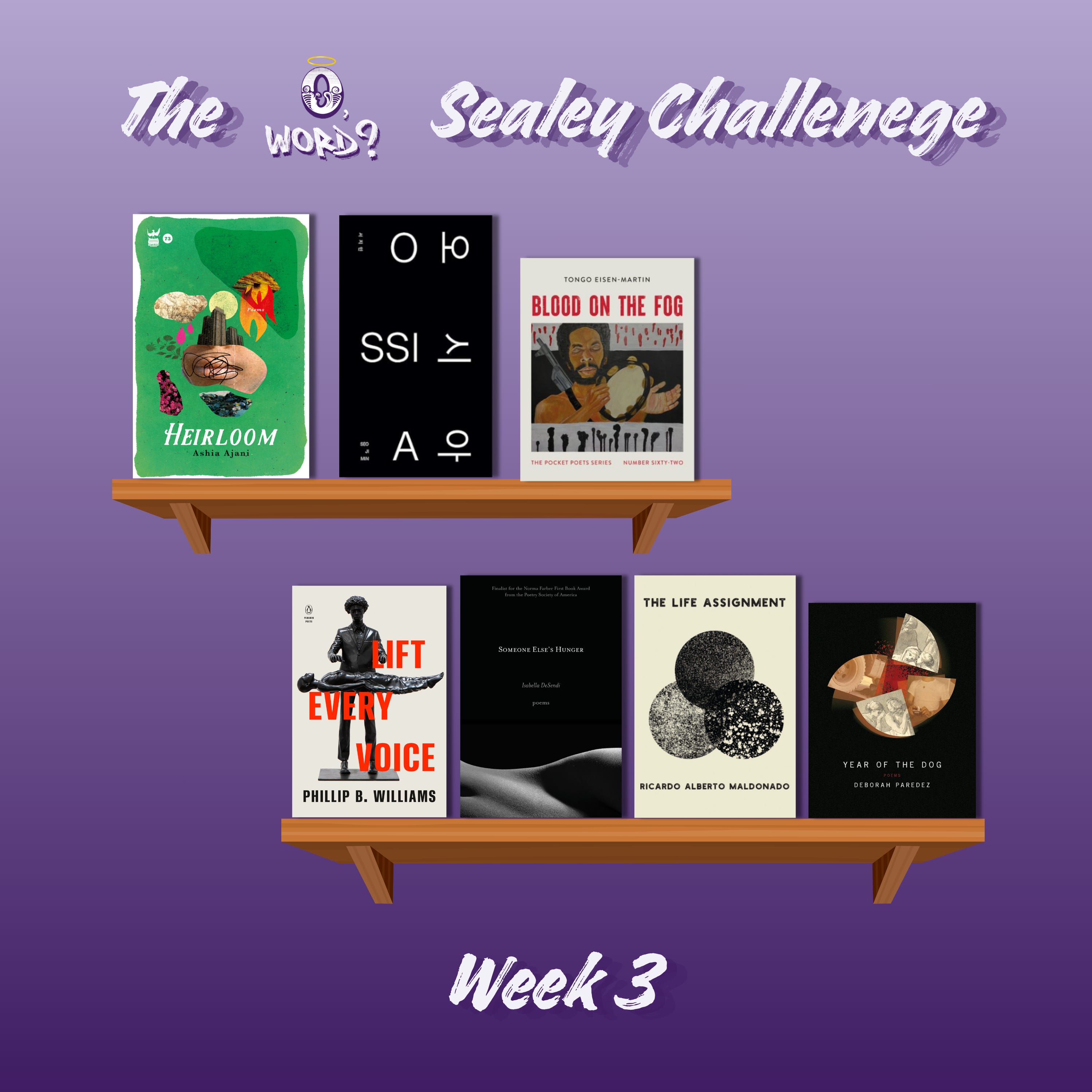
The O, Word? Sealey Challenge | Week 3
Reading Ajani, Seo, Eisen-Martin, Williams, DeSendi, Maldonado, & Paredez

Helllllloooooo, poets of the internet! Week 3 is down, which means we are more than halfway done with this year’s Sealey Challenge! There are still two more weeks of the Sealey Challenge to get through, but let’s dive into this past week’s reads!
Reminder of the ★ System:
★ ★ ★ ★ ★ — Personal fave!
★ ★ ★ ★ — Terrific!
★ ★ ★ — Pretty good!
★ ★ — Book likely disappointed me in some way.
★ — I cannot, in good faith, recommend this book.
1) Heirloom by Ashia Ajani
Genre: Poetry (Debut)
Archetype: Playlist
Rather, I embrace the freedom
of exodus. When one of Us runs, the rest follow.
- pg 27, "Running"
Ajani's debut reads like a sacred text, full of scripture of ecology & Black upbringing. In this collection, Ajani tends language & nurtures it into something lush & lyrical. The speaker possesses a great awareness of our ecological realities, saying what is natural about prolonged neglect? what is natural about disaster cycling? In times such as these, we must pass down new stories about ourselves, who we sprouted from and the futures we are looking to cultivate. This collection is the first seed toward a world that can sustain us.
Rating: ★★★★ | Language is very rich & grounded in a vibrant ecological landscape
2) OSSIA by Jimin Seo
Genre: Poetry (Debut)
Archetype: Playlist
Isn't learning a new language jus a new way
of saying the world we live in isn't enough?
- pg 42, "Richard Translates"
Richard, forget it. Forget the lesion in my voice, writes Seo in one of the collection's many epistles. Mirrored & translated from Korean on the next page: Erase it/ Erase the wounds hidden within that voice. It is the space between these translations that makes this debut so compelling. "Ossia" is a word referring to an alternative arrangement of music. OSSIA is a composition of choices. It is an elegy with a deer running through it, a conversation with ghosts in a hallway of mirrors & echoes. This collection pushes the reader to distill meaning from both what is represented on the page & what is buried underneath.
Rating: ★★★★★ | What I sometimes lose in clarity is made up for by this collection’s music & daring
3) Blood on the Fog by Tongo Eisen-Martin
Genre: Poetry (Third Collection)
Archetype: Playlist
The police are always american/ anywhere on earth
- pg 83, "Fomenting Poems"
Almost immediately after starting this collection, I was reminded of the work of Bob Kaufman, from both the rhythm of Eisen-Martin's syntax & the candor of his pen. This is a book that does not shy away from social critique, indicting the systems that profit off the suffering of the over-policed everyday people. There is a clear Beat influence, really adding to the importance of place for this San Francisco-based writer. I think any one of these poem shine individually; as a collection, I think I sometimes found myself wondering if certain rhetorical moves were done without enough variation, but found that to be less of an issue in the book's latter half. Solid collection to check out.
Rating: ★★★ | The work is good & commentary necessary, just a bit more variety within the poems would have been welcome
4) Lift Every Voice by Phillip B. Williams
Genre: Poetry (Third Collection)
Archetype: Playlist
Is there such a thing as hope that is not
eventually weaponized? What is silence
if not blood, but over there?
- pg 60, "Paradise [If I remove myself from this world maybe]"
Williams' newest collection is truly a chorus of influences, from Toni Morrison & Sade to John Milton & Luther Vandross. Part elegy, part requiem, this collection is, as one might expect, rich with music. Throughout the poems, Williams plays with form & sound, sculpting a landscape as sonically compelling as it is vivid. They grapple with addiction & loss & inheritances of grief. It ends with a stunning golden shovel derived from James Weldon Johnson's famous anthem. Every part of this work gleams with song.
Rating: ★★★★★ | Impressed by the breadth of form & language in this collection, every repetition felt intentional & important to the collection’s broader project
5) Someone Else’s Hunger by Isabella DeSendi
Genre: Poetry (Debut)
Archetype: Speaker’s Journey
As a cowboy first lays leather on a mare
teaching her to accept the weapon
that will dictate her life, so you taught me
the gentle language of hurt
we would speak.
- pg 38, "What I Thought I Knew of Life"
DeSendi's remarkable debut reminds us that desire, even our own, does not always come without blood. The urge towards retribution cannot always be neatly explained. This account takes us on a journey through the throes of hunger, the hunger of other bodies & the insatiable voids within ourselves. The body becomes a vessel borne of other violences. Even still, there is so much beauty to experience, so many ways to understand our wants. DeSendi channels the voices of Medusa, Eve, Eurydice, & others, but the most compelling one is always her own, her masterful lyric.
Rating: ★★★★★ | DeSendi’s language is so precise & specific, a somatic experience as much as it is a sonic one.
6) The Life Assignment by Ricardo Alberto Maldonado
Genre: Poetry (Debut)
Archetype: Playlist
I begin. You begin. We begin often. How strange is the Kingdom
of Heaven.
- pg 35, "One Fish, Two Fish, Three Fish/ Un, Dos, Tres Pescados"
Reading this collection, I immediately thought about Jimin Seo's OSSIA (recency bias, I know), highlighting the relation between the original & English translations of many of the poems. There is an interesting consideration of what can be accomplished in both languages. In "In Defense of The Life Assignment," a line reads I was desperate under summer's/ isosceles. From the original Spanish, my translation app translates the line as I wept under the isosceles sky/star of June, even without presence of the words cielo or estrella. The distance between the versions are acknowledged & intentional, the book a constellation of mirroring, but not quite identical, abstractions. This is a book that asks for your full attention, & makes good on the investment.
Rating: ★★★★ | I am usually abstraction-adverse, but Maldonado’s craft did a good job keeping me engaged even when the images stretched their wings
7) Year of the Dog by Deborah Paredez
Genre: Poetry (Sophomore)
Archetype: Memoir
Synonyms for aperture: mouth —
gap — chasm — hole — rupture — perforated passage — eye.
- pg 20, "Year of the Dog: Synonyms for Aperture"
Here is a collection that exemplifies what I appreciate most about poetry: poetry as a site of rhetorical disruption. Poetry as a magnifying glass to the obfuscations of the state. Poetry as witness & archive & record-setter. Where language fails us, this collection shows us how poetry fills the gaps, approaching the page as a space to let questions speak to each other. I was enthralled by the range of form in this book & a clear sense of how the structures of each poem felt intentional to their final construction. A must-read, especially for anyone interested in docupoetics.
Rating: ★★★★★ | Easiest 5 ★ I’ve given this Sealey Challenge thus far. Fan of the forms & clear, intentional work that was put into this collection, feels in conversation with Solmaz Sharif’s “Look” & Layli Long Soldier’s “WHEREAS” in regards to failure of both language & the state
Thank you for rocking with me another week. I hope you’ll check at least one of these collections out. See you next week!