


Hellooooooo poets of the internet. Have you ever had that thing happen to you where you passed the imaginary deadline you made for a thing you were trying to do, and after you missed that deadline, it felt more and more impossible to return to said thing? No? Just me?
Well, this is me trying to get back into this project of a newsletter I set out for myself. Cozy up, cause in this post I’m reflecting on the summer, my journey doing the Sealey challenge (along with a breakdown of the whole '“archetype” thing some of you asked me about), and some things I’m looking forward to regarding this Pubstack in the future (yes, I’m still trying to make Pubstack ™ a thing). And hey! Thanks for being here :)
Where in the World Have I Been?
No one is asking that question, but I’m going to answer it for you anyway, cause that’s how I am. In short: everywhere! In long: nowhere at all, really!
Because of my job, summer is the busiest time of year for me. I help to oversee a program that, in the summer, involves me overseeing 150 middle- and high- schoolers everyday for a month, not to mention their undergraduate advisors that have their own set of worries and wishes and life happenings to attend to. I absolutely love this job… and it is also the most tiring part of my year. I get home from work each day in July ready to fall into bed, and the next thing I know, I’m up to do it all again. And this is just from ONE MONTH of doing this. All of this is to say: please thank the K12 teachers in your lives. They are truly God’s strongest soldiers.
July is also an emotionally draining time because it marks the anniversary of my mother’s1 passing. I know what you’re thinking: how many times is DeeSoul going to work his dead mom into a story? And all I can say is, if you knew this woman like I did, she’d be on your mind all of the time too. The Dead Mom’s Club is a strange one to be in, especially as a poet, but I am grateful for the work of many poet friends that has gotten me through the past year of that transition. While I am noticing that poets have a LOT to unpack about their parents, I am always so inspired by the endless ways we can talk about the people who have molded us into the people we are.
Some other things that happened this summer: I was named a 2025 Ruth Lilly & Dorthy Sargent Rosenberg Fellow AND I had the awesome opportunity to be a Sun Valley Writers’ Conference Fellow, thanks to the invitation of my former professor. The experience was so much more insightful than I even expected it would be, and it was nice to imagine, at least for a few days, what kind of world we could live in if writers were regarded in the way we regard our doctors and lawyers and other kinds of well-regarded people.
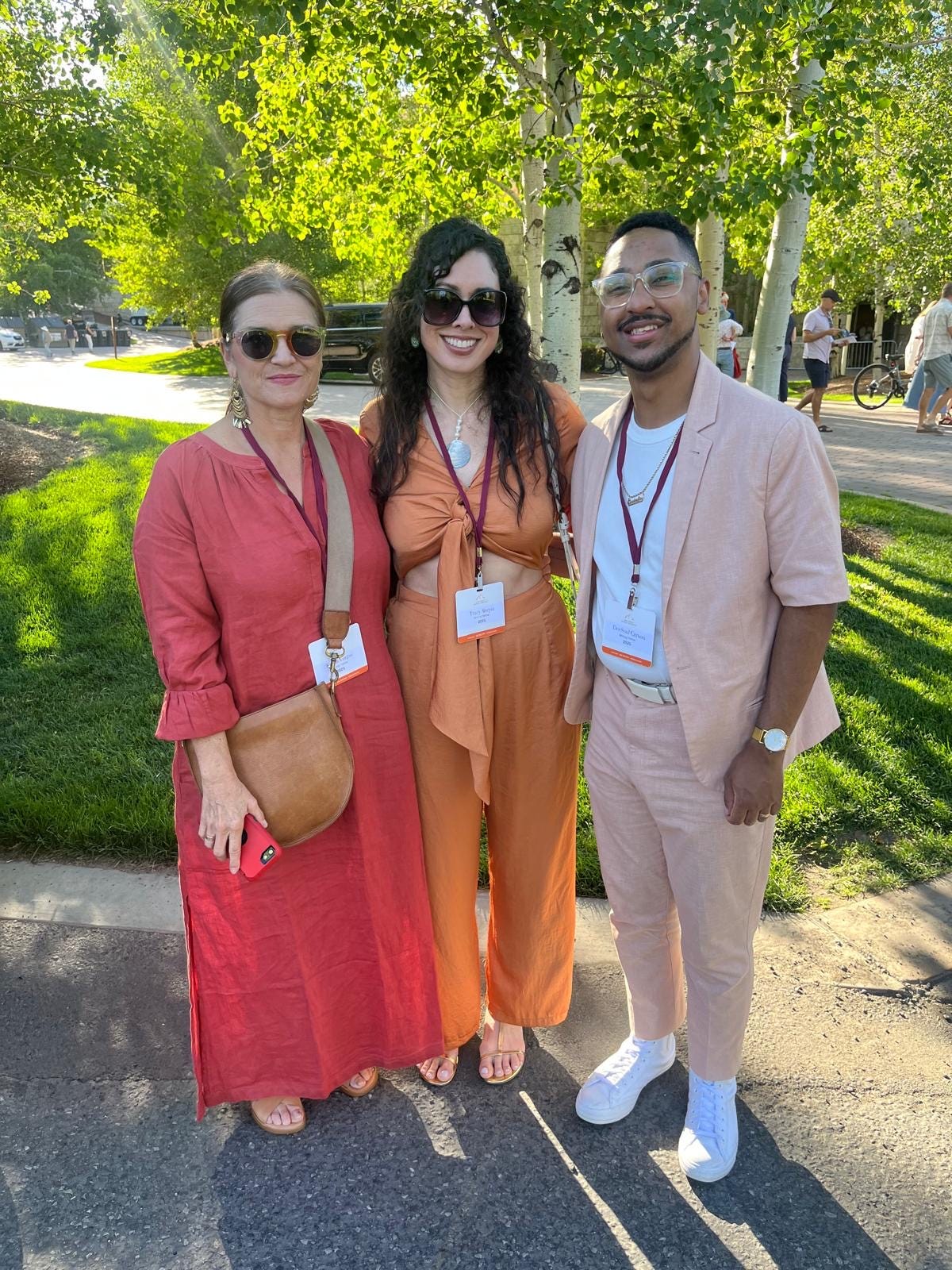
It was also very strange to be in a place marked by so much wealth and where so many of the attendees looked… not like me. There was an interesting thought that occurred to me, not just about who gets to write and have their work lauded as a writer, but what demographics of people are afforded the time to read and then shape conversations about literature. As I found out during The Sealey Challenge, having the time to maintain a consistent reading is a privilege. My ability to read 31 books in one month was greatly aided by having a job that’s workload decreases greatly in August.
Many of us suffering under capitalism do not get this same kind of break, and that kind of obstacle really limits the conversations we can have with folks. Imagine a world where work wasn’t our life, where we were afforded the time to go and learn more about our interests, reading or television or gaming or knitting or dancing or so much more, a world that valued our artistic enrichment as much as it capitalizes on our productivity. A bit of a tangent, I know, sorry, but what a thought!
The Sealey Challenge (and a breakdown of what I read)
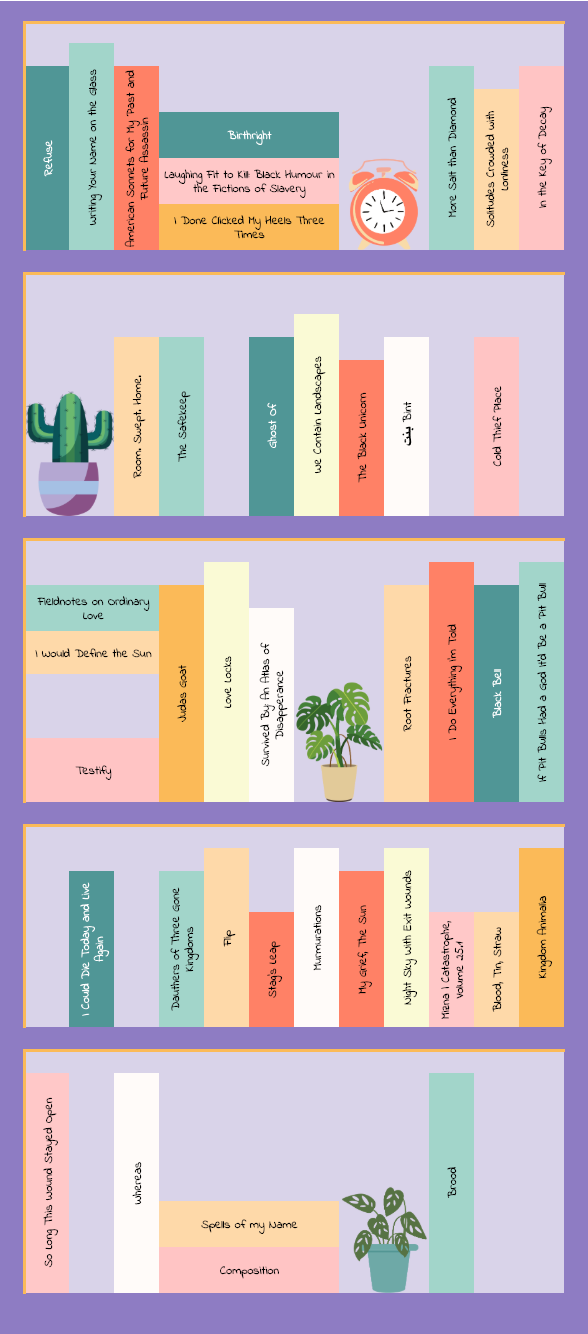
As mentioned above, the other major part of my summer was participating in the Sealey Challenge.2 It has been a while since I attempted this challenge, frankly due to the stamina it requires, but I was motivated by the Open Books fundraiser for the Sameer Project. I documented my reading journey on my instagram story3 and posted daily reflections on the books I read, but something I got several questions about was my “archetypes” category in my reading journal.
I’ve briefly touched on it before, but the archetypes thing comes from a talk I attended by Franny Choi at the Watering Hole Writing Retreat.4 In this talk, Choi presented us with four kinds of collections poetry books can fall under, and being a visual learner, I synthesized this into a kind of graph for myself. This framing has helped me think about the ways I put collections into conversation by considering two dimensions that comprise the book-shaping experience: What drives the collection (concept or emotions) and what dictates the ordering collection (are the poems ordered in a way that makes logical sense or emotional sense?). These two dimensions create four possible kinds of books you could encounter, but as I found through my reading, it does not encompass what every book is trying to do, requiring a flexibility of these archetypes. Below, I will offer a more specific explanation of the book archetypes I encountered and which books (for me) fell under them.
I think it is important to note, however, that the way one receives a book is subjective, despite the author’s intentions. How I classify a book may not be the way you classify a book, and that’s okay! I think it is more important that you form a vocabulary for work that suits you and helps you to put things in conversation with one another.
The Speaker’s Journey
The first four of these archetypes are taken from those presented in Choi’s talk: The Speaker’s Journey, The Essay, The Playlist, and The Formula. Of these, I believe the Speaker’s Journey is perhaps the quickest to identify, although I complicated the category a bit for myself later on. Although the “properties” for these categories are flexible, collections in this archetype seemed to me to be ordered in a way that was logical for the speaker. This does not necessarily mean we started at the beginning, but there is some kind of narrative that the reader is led through. The collections are driven emotionally by the stakes of the narrative and the speaker’s relationships. In short, the collection is telling us a story of the speaker in verse that we piece together as we move forward.
Examples from My Sealey Challenge:
Cold Thief Place by Esther Lin
Love Locks by Kieron Walquist ★
Root Fractures by Diana Khoi Nguyen ★
Stag’s Leap by Sharon Olds
So Long this Wound Stayed Open by Juliana Chang
The Essay
The second archetype, The Essay, can sometimes be a bit harder to pin down, but I generally interpret it as a collection that is prompted by a central question, argument, or artifact, with poems circulating around that central point. For example, I would categorize my own collection, The Laughing Barrel, in this archetype (and yes, this is a shameless plug). The central artifact, the laughing barrel, is an image that encapsulates the absurdity of racism and the thin line between joy and survival Black people face, and the poems in the book (as much as I can help it) respond back to that image. Collections in this archetype are often ordered in a seemingly logical way as they build the argument, and some poems in these collections may serve to support the work’s argument, as opposed to standing on their own. In this same vein, they are driven by their concept or question and seek to speak back to it throughout the work.
Examples from My Sealey Challenge:
We Contain Landscapes by Patrycja Humienik
Bint بنت by Ghinawa Jawhari
Judas Goat by Gabrielle Bates
Survived By: An Atlas of Disapperance by Stephanie Niu
Black Bell by Alison C. Rollins ★
Composition by Junious Ward
The Playlist
The third archetype, The Playlist, is all about vibes. Instead of communicating a clear narrative like the Speaker’s Journey or an argument like the Essay, the Playlist often centers itself around a feeling — love, loss, loneliness, anger, hope. These collections are more interested in walking us through an emotional journey than a hero’s journey. Poems in these collections are often ordered in a way that centers the emotional arc, the momentum that carries readers from one poem to the next. Poems in these collections (with exceptions, of course) do not lean on each other as much as they seek to uphold the emotional umbrella of the work.
Examples from My Sealey Challenge:
Ghost Of by Diana Khoi Nguyen ★
The Black Unicorn by Audre Lorde
Testify by Douglas Manuel
I Would Define the Sun by Stephanie Niu
Fieldnotes on Ordinary Love by Keith S. Wilson ★
I Do Everything I’m Told by Megan Fernandes
Flip by Victoria Mbabazi
Night Sky With Exit Wounds by Ocean Vuong
Mizna | Catastrophe, Volume 25.1 (Periodical) ★
Kingdom Animalia by Aracelis Girmay
Spells of My Name by I.S. Jones ★
Brood by Kimiko Hahn
the space between men by Mia S. Willis
The Formula
The last of the original four, the Formula, is the most “you know it when you see it” of the bunch. This archetype encompasses collections with very specific kinds of rules for themselves. I actually don’t have any books from the challenge that I read that fall under this category, but one I read earlier this year would be American Sonnets for my Past and Future Assassin by Terrance Hayes. In this collection, every poem shares the same title, and they are all sonnets that rope into heroic sonnets. This tight formal constraint, like those of other collections in this archetype, rules the book and its structure. While not always as concerned with an argument or narrative, there is an emphasis on play and engagement.
The Soundtrack
As I progressed farther into my challenge, I realized that the four archetypes weren’t completely encompassing the books I was reading, and how could they? There are as many ways to write a book as there are writers. With that in mind, I added new archetypes that would help me give language to the books I was reading. If I was to do the challenge again, I’m sure some of the books I categorized in the beginning would fall under these additional descriptions.
The first new archetype was The Soundtrack, which I felt had aspects of both the Playlist and some combination of the Essay or Speaker’s Journey archetypes. As a playlist, the collection still has an emotional drive, and I believe the ordering is also governed by a desire to attend to the emotional journey of the reader. However, the poems themselves I feel are more closely related to their central concept and each other than I sometimes see in Playlist collections, feeling more to me like the soundtrack of a conscious project than various translations of a feeling.
Examples from My Sealey Challenge:
If Pit Bulls Had a God It’d Be a Pit Bull by Gabriel Ramirez
I Could Die Today and Live Again by Summer Farah ★
The Memoir
The second archetype I added was the Memoir. Now, I know that memoir is its own genre and I don’t seek to disrupt that, but I do think it is interesting to consider a poetry collection as a memoir. For clarity’s sake, the way I usually distinguish memoir from biography is that a memoir is concerned less with the facts of one’s life and more with commenting on one’s personal experience of a specific personal phenomena, an illness or a recurring event or something of that sort. So in that way, the Memoir archetype connects the personal aspect of the Speaker’s Journey with the central concept or argument found in the Essay. Is that just me poetsplaining what a memoir is? Possibly. Likely. Nonetheless, it’s here now, so do with it as you will!
Examples from My Sealey Challenge:
Daughter of Three Gone Kingdoms by Joan Kwon Glass ★
Murmurations by Anthony Thomas Lombardi ★
My Grief, The Sun by Sanna Wani
Blood, Tin, Straw by Sharon Olds
The Experiment
My final archetype (at least for now) is the Experiment, which I view as a combination of the Essay and the Formula. The best way I can describe it is Weird for a Reason ™ . In a collection in this archetype, the poems themselves take a lot of risks and play with the page in some way, either rhetorically or visually. However, the risks and poems of the books aim to speak back to a central argument or question the book is holding. As a whole, the collection is trying out different entry points into the conversation the book is inviting.
Examples from My Sealey Challenge:
Whereas by Layli Long Soldier ★
What next?
I think that’s it for this newsletter, but I’m excited to say I’ve made some headway into the ultimate goal of this newsletter/podcast, which is to interview poets on craft elements that mean something to them. I have an interview with a friend and poet that I’ll be sharing in the next installment of this newsletter, as well as a conversation with a poet at the top of their craft that I’ll be interviewing for my Eponymous series, which looks to talk to writers about their collections, their names, and where they come from.
Thanks for rocking with me this long. Until next time :)
An additional note that I debated putting in the main post: some of you know that the mother I keep referencing is my stepmother. My biological mother is still very much alive, but much of this year has been simultaneously mourning my stepmother’s death while also fielding some of the very hateful things my bio mom has said about her that I’ve had to defend. In many ways it feels like I have lost two mothers, and that’s a thing I’m still trying to navigate.
From The Sealey Challenge FAQ: “The Sealey Challenge is a community activity in which participants read a book of poetry each day during the month of August. Since 2023, Nicole Sealey has entrusted the University of Arizona’s Poetry Center with caring for this incredible month of reading poetry.”
You can still see my individual reviews in my highlights!
Highly recommend this retreat for any writers of color!