


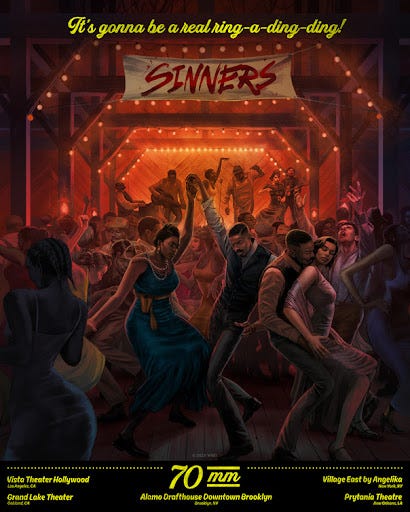
Y’all. I have to talk about SINNERS. I need to talk about SINNERS. The issue is that every time I try to say something coherent about SINNERS, it comes out as an incoherent mess (the same reason I dare not venture into memoir writing). If you want to read some good thoughts about it, I recommend reading Olivia Selam’s Substack article on the movie and some of the questions it raises. My thoughts will not be ~as~ well formulated, but I do want to preface my rambling with this tweet by Ajanaé Dawkins *SPOILER ALERT?*:

I saw this tweet from Ajanaé after my first watch of the movie, and I really love the line of questioning it takes. I’m really focused on her question - “what you think spiritual intervention looks like?” What do we expect from God or any higher power we put our faith in? She expands on her questions with the following:

To approach this question, I have to go back to the strongest example of faith that I’ve seen: my (step)mother.
SINNERS is a movie that is considering, in part, our legacies, the ones we adopt from our people, the ones expected of us because of our shared blood, and the ones forced upon us from the horrors and whims of history. Our legacies, of course, are all tangled up in one another, weaving in and out and tying us together. Part of the resonance I feel with this movie (and the reason I’ve seen it four times in the past month) is because I am feeling the particular weight of the legacy passed down to me.
May is the month of my mother’s birth. Last May was the last time I saw my mother before she passed away. For much of her life, my mother was afflicted with various illnesses and conditions, ultimately discovering a Stage-4 cancer that should have been caught months prior by her doctors. In many ways, I considered her to be a Job-like figure, whose faith and goodness, as far as anyone could be good, was constantly being tested by God. Despite her constant afflictions, even as her body slowed and she was nearing the conclusion of her life, she maintained her faith. You might even say it grew stronger. With each passing day, she proclaimed her trust in the Lord, she comforted those around her, and she made her peace. Not once did she give up on God, even when on the outside it seemed he had stacked the cards against her.
Truthfully, this confused me. It aggravated me. All my life I was led to believe our actions were the true measure of our character. What was happening to my mother, in my mind, was not the will of a loving God. I had to deal with that very question that Ajanaé poses: what is it that I expected of God? What did I think spiritual intervention should look like?
There have been arguments that SINNERS is an anti-church movie, but I think it’s much more complicated than that. When Sammy prayed that Lord’s Prayer — when my mother gave her daily thanks — what would it have it have taken for us, for me, to believe his faith had real power? A Hand coming down? A Voice bellowing from the clouds? A Snap to make the maligned blood or bloodsucker disappear? As Ajanaé notes, our faith has never prevented the horrors inflicted upon us, so how do we measure their effectiveness?
And the answer, I think, is us. The measure of a practice’s effectiveness is what we believe it to be. Which is really corny answer, I know, but chewing on that has helped me come to terms with my mother’s passing. It hasn’t made me less angry. It doesn’t make me wish it didn’t happen to her in the first place. But that practice gave my mother the peace she needed to let herself receive that final rest. That prayer distracted Remmick long enough to see the sun.
There are of course things in the movie I would have like seen troubled or explored more, but I appreciate the legacies of faith, violence, and community the film is holding. Makes me feel that more empowered to approach those legacies in my own work.
What’s Going On? (with me)
On Friday, June 13th, I’ll be reading for the Speak, Light summer reading series at Accent Sisters, alongside Dylan Gilbert, Laetitia Keok, and Tianyi. Register here.
On Thursday, June 26th, in collaboration with Saturns Wilds Motel1, I will be leading a workshop titled “Game Mechanics in Poetry: Form, Function, and Expanding What Poetry Can Be.” We’ll explore how video games and other visual media can serve as generative frameworks for writing poetry and rethinking the written word. There’s a sliding scale of $20 - $40. Register here.
On Monday, June 30th, I’ll be reading at the book launch for Anthony Thomas Lombardi’s debut collection of poetry, murmurations. There will also be readings by Rhoni Blankenhorn, Megan Pinto, John Murillo. $5 virtual/ $9 in person. Register here.


My Happenings this Month


What’s Happening? (with my friends)
Speaking of Ajanaé Dawkins, she recently released her chapbook, Blood-Flex, winner of the 13th Annual New Delta Review Chapbook Contest. For a taste, check out this reading of her poem “O Eve, I Could Never Hate You” (Shoutout to the apostrophe O).
I.S. Jones’ debut full-length, Bloodmercy, is forthcoming this year in September 2025. The collection “reimagines Cain and Abel as they navigate the dense geography of girlhood into young womanhood to explore violence, love, sex, faith, and man’s dominion over the earth.” For a preview, read two of her poems published in Brooklyn Rail.
jason b. crawford’s sophomore collection, Yeet! is forthcoming from Omnidawn this year! The collection “envisions the Black community lifted off the earth and set free towards the stars.” While you wait for this drop, check out crawford’s first collection, Year of the Unicorn Kidz.
Kay Bancroft’s debut poetry collection, Bloodroom, is forthcoming from Sundress Publications in Summer 2026.2 In Bancroft’s own words, the collection is “ full of explorations, of diving into intergenerational trauma, parent/child relationships, identity, queerness and sexuality, pop horror from the 90s to now, and some freaky cool hybrid visual poems,” which I’m always a fan of.
Reuben Gelly Newman’s debut collection, Dear Dear, was chosen as the winner of Trio House Press’ 2025 Louise Bogan Award winner. It features “queer love poems and their politics against a backdrop of today’s warming worlds and a fraught America” and is forthcoming in July 2026.
Dr. Taylor Byas’ sophomore collection, Resting Bitch Face, is forthcoming on August 26th with Soft Skull Press. It is described as a book for women, for Black women, for lovers of art and film criticism, and for writers interested in work that finds a middle ground between poetry and prose. If you want a good introduction to Byas’ work, check out her first collection, I Done Clicked My Heels Three Times.
What I’m Reading
1) Solitudes Crowded with Loneliness by Bob Kaufman
Genre: Poetry (debut)
Archetype: Playlist (heavy on play)
I want to prove that the sun was born when God fell asleep/ with a lit cigarette, tired after a hard night of judging. - “Unholy Missions”
I was first introduced to Kaufman through a bonus weekend workshop Professor Terrance Hayes taught during my time in the MFA program. I was immediately intrigued by this Beat poet I hadn’t heard of before and the rhythm of his work. Kaufman uses words in combinations I didn’t even know folks could do. Just an incredible dexterity of language, sound and humor. It is a true shame more people don’t recognize his work & and his contributions to Beat Poetry (which I’m sure is now changing), but I am grateful to have been introduced to it. His clarity and fluidity are something to strive for as much as they are marvels to admire.
2) In the Key of Decay by Em Dial
Genre: Poetry (Debut)
Archetype: Playlist/Essay
And at the scale of geological time,/ the epoch in which violence ripped across lands/ like a seed planted without prayer, will appear/ brief as a keyhole - “Necropastoral for the Anthropocene”
Long (but not too long) before this book came out, I knew Em as the coach of my college slam team, whose care and close attention was vital to me as a baby poet. Much of the confidence I gained as a poet, I gained because I knew Em. In the Key of Decay is interested in the failures of both the natural and human-intervened world. As such, it places itself squarely inside considerations of the Anthropocene and the human tendency to fuck shit up. Despite this, the book is not defeatist, and Dial does not despair, Instead, the book considers how, in a world of failures — medical failures, the failure of race/science, empire — do we make space ourselves? How do we sing our own songs? Overall, a really great collection of ecopoetry (with a really gorgeous cover).3
3) Room Swept Home by Remica Bingham-Risher
Genre: Poetry (Fourth Collection)
Archetype: Speaker’s Journey
What will love demand forever? What can we make clean? - “I. Unlike my grandparents, I thought the past was a country to which I could return” from the Lose Your Mother suite
I don’t know what I was expecting from this collection, but I was completely blown away. Remica joins a long line of Black women poets engaging with archive and pulls from it something so incredibly musical & sincere & new. Our histories are alive in this book, in her hands. This collection shines a light not just on the daily injustices of this country, but also on the way our lineages persevere how we all make it back to a home swept clean. This book is a great example of received forms working to reinforce content, and a masterful consideration of archive.
New Poems in the Catalog
“being property once myself” by Lucille Clifton
“Etymology of ‘Fuck 12’” by Darius Simpson
Saturn Wilds Motel is a fairly new space interested in speculative, hybrid, interactive, and multimedia work. If that’s your vibe, send them an email!
As you can see, there’s a lot of blood being invoked in this pubstack. Is that a recession indicator? Perhaps. Anyways, check out two more collections in the blood family, Bloodwarm by Dr. Taylor Byas and Blood Dazzler by Patricia Smith.
This book is published by the same press that published my friend Vic’s book, Siren in the Twelfth House.