


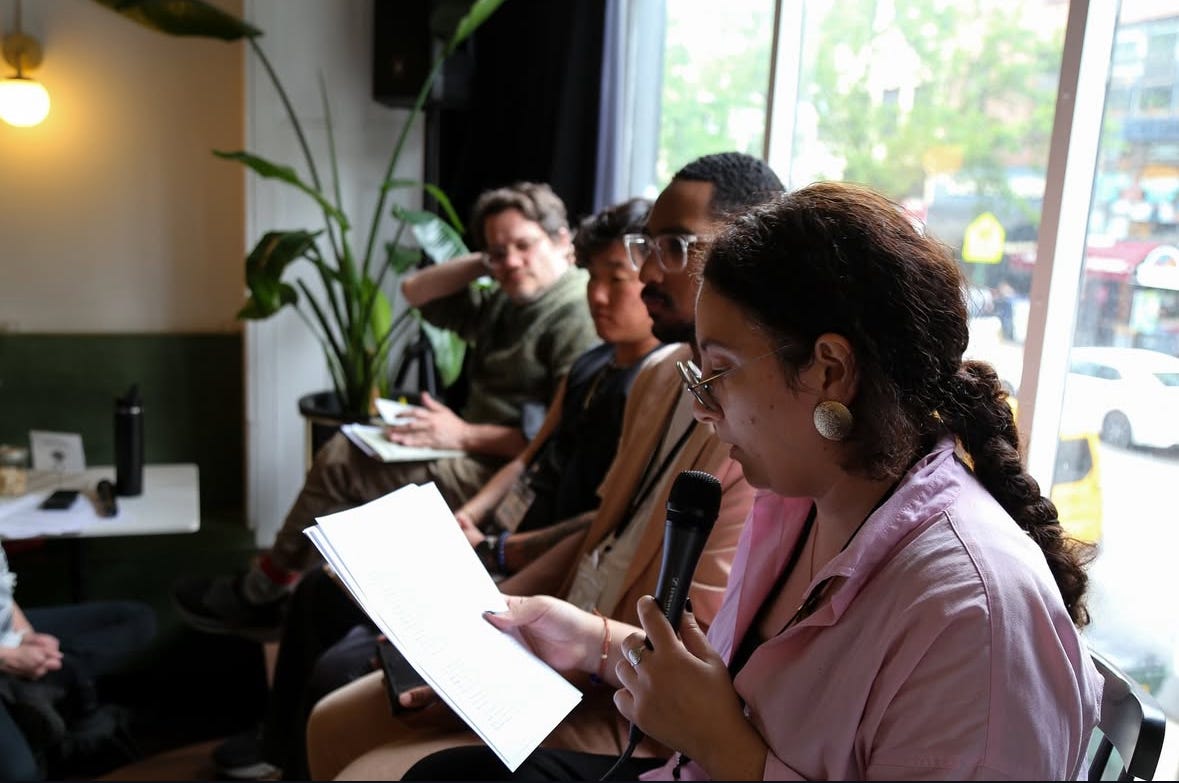
Photo Credit: Brooklyn Poets
Last week I had the pleasure of being at the Brooklyn Poets Poetry Festival and sharing the stage with Lara Atallah, Noah Arhm Choi, and Ricardo Alberto Maldonado, considering the responsibility we have as workers of language in a country that weaponizes language. I was honored to be part of the panel, and since I drafted my remarks in Substack anyway1 , I figured I would post them here (with slight editing for clarity). To start, here was the description of the panel, titled “A Language That Could Produce This”:
Is language the box we find ourselves locked in or the key to its escape? What does it mean to write against oppression, against trauma, against empire, against our own histories—using the same language that created them? What tension do we hold when we write for our survival using the same words that form legislation that renders us at best unimportant, and at worst, nonexistent. In this panel, we’ll explore a question “What does it mean to be a poet working in a language, a medium, a nation, that can produce this?” raised by Kaveh Akbar with poets that poke and pry at the edge of language. We’ll learn from poets working in translation, found materials, multiple languages and more what it means to work in a language that could produce this and what opportunities and responsibilities we have in doing so.
And, as promised (threatened?), my remarks below:
I think my first question for any panel is “who the hell is this guy and why is he up here,” so hopefully I can answer that for you briefly. For the last several years, I have been working on my debut manuscript, The Laughing Barrel2, which is an examination of Black joy and perseverance in the face of relatively ridiculous circumstances. For context, the laughing barrel3 is a slave-era construction in which enslaved people who felt the need to express laughter or other emotions would have to go to a barrel in the field and lean in to laugh to disguise their laughter from their enslavers.
From this construction, the absurdity of having to hide one’s joy for fear of literal bodily harm, I am interested in the various absurdities that permeate our lives, those of racism, capitalism, genocide, and constant personal & communal grief, among others. I am interested in how Black people maintain their joy and sanity – sometimes fashioned from nothing – despite the violence the world subjects us to daily and historically. In my work, I attempt to set considerations of faith, God, and our fraught histories next to scenes of the things and people that keep our joy alive.
As I turned this panel’s topic over in my head, “A Language That Could Produce This,” I struggled with how to enter this discussion, which is to say, there is no shortage to the ways language rules over lives. Indeed, at this very moment, the language of the state — which is to say, empire, which is also to say, fascism — attempts to hinder or altogether stop the work of writers, artists, and other culture-makers and shapers in this country. What we know is that a populace that is able to interrogate art, culture, and language critically — a populace that is able to think for itself — is a populace that is dangerous to the overseer class.
To the opposition of this knowledge, multimillion dollar corporations push the use of AI, which only serves to stifle curiosity and argument-refinement skills in a system that values somewhat arbitrary measures of success over the real work and effort, however imperfect, of critical engagement . The state continues to ban books in schools that help open the minds of our young people. It bans funding to research that aims to understand and improve the lives of those historically marginalized in this nation. The state is attempting even to ban language that would suggest solidarity with the people it profits off the genocide of.
I am getting away from myself, but all this is to say, there’s a lot to language. And thinking about this, my mind ended up in two places. One of those places was thinking about babies. I promise I will circle back to that in a moment, but I would like to first touch on the other place my mind went to, which was Solmaz Sharif’s4 poem “Social Skills Training.” To those who may not be completely familiar with Sharif and her work, she is an Iranian poet and the author two poetry collections, Look (2016) and Customs (2022), both of which I highly recommend as reading for those interested in this panel’s topic.
In both of these collections, Sharif is thinking extensively about the violence of language, particularly the English language. Look repurposes language from the Department of Defense Dictionary of Military and Associate Terms, highlighting the euphemisms this country employs in service of downplaying the horror of its imposition in other countries. Customs, the book the poem I’m about to read comes from, turns from the language used to justify inconceivable violences abroad to the language employed within the state itself in an effort maintain its own tumultuous existence, meant to exhaust and exempt those trapped in its belly. “Social Skills Training” by Solmaz Sharif reads as follows:
I will not be catching a case from the copyright/first publisher’s rights people. You can read “Social Skills Training” here
This is a poem I appreciate and return to often. I believe one of the many things it highlights for me is the precarity of language in a country that feels perpetually threatened by it. The nation-state is a victim of its own mind, and thus projects that fear unto those who are actually at its mercy. Too often, we are the ones who must be careful with our language for fear of being victimized when all the power rests with those who wield language with the least regard for their common man.
The frustration of this dilemma, a occasional sense of helplessness without a way to properly express it, brings me back to babies. Last week, I was in this space for the spring workshop showcase (very very good work from those students, might I add), and during one of the intermissions, my husband’s friend brought her baby in for a second before she had to head home to take care of said baby5.
Sidebar — Seeing the baby in this space was a real joy and we don’t see nearly enough babies/children at poetry events, and I think that should change! We are too stuffy as a group of people and I think that we could benefit from the natural restlessness/energy/noise that children provide.
The baby obviously agreed with me, because as soon she was handed to a friend to hold for a second, she cried as loud as her little lungs could muster. I know people are generally very put-off by babies crying, all of us forgetting that we were too at some point the delicate screaming thing in someone’s nervous arms, but in that moment I really emphasized with the kind of daily horror babies are faced with.
Just imagine, if you will, that every moment of your very new existence is dictated by powers outside of your control. Some of these powers have faces you will learn to recognize, but everyday you are thrust into a world that is bright, and loud, and noisy, and generally not suited for babyhood. All the while, you have to deal with indigestion, and straps that too tight, and diapers that need changing , and teeth fighting their way out of your gums, and to top it all off, you have no language to properly communicate all of this discomfort to anyone. So all you can do is scream and hope someone will interpret that discomfort correctly and take the proper steps to relieve you.
That feeling, that simmering frustration with a lack of language for what is happening to us, is what I feel many days in this country. I feel like a child trapped with every feeling I know I feel but do not know how to express in a way that will not bring me harm. Every morning, I read a headline that makes me go Oh my God, what is it now? What can I do but scream? When my government doesn’t hear me and when “well-meaning” neighbors have no desire to see the violence against innocent people end and it feels like I am trapped in a maze of semantics, technicalities, and absurdities?
It is for this reason that I am grateful for artists. I am grateful for poets, and playwrights, and occasionally, I am even grateful for the fiction writers. Particularly if they are also poets. As we grow past toddlerdom, we are given the language that helps us to process and approach the world we encounter new every day. In the gut of a nation hellbent on using language to divide us, to distract us, to steer us from the work we hope to do, it is the role of the poet to show us what language can do to combat empire.
It is the poet’s job to bear witness to our stories so that no one can say that our histories did not happen. It is the poet’s job to provide language and images that force us to stop and think, to slow down and consider the work the language of empire is doing in making us forget. It is the poet’s job to remember what has happened to us and to make sure the knowledge is passed down so we know how to handle what is thrown at us. It is the poet’s job to help us imagine new and better worlds for ourselves, to language us to a reality better than one we find ourselves in. Our language should challenge us. It should push towards new ways of languaging ourselves. And as long as language is used in service of power, we should make sure we are doing what we can to expose the failings of the state’s limited imagination and take that power back.
Pro-tip: The Substack post editor gives you both an approximate reading time and an approximate speaking time for your posts. Helpful when your remarks need to hit a certain time frame!
Of course I had to plug myself a little bit, it’s rough out here!
As I say every time I mention this project, there is a slight murkiness in the true origin of the barrel, but the through-line is that’s purpose was to suppress Black laughter to maintain some shallow definition of “peace” in white-dominated society
I think Solmaz Sharif was mentioned on separate occasions each day of the festival, in several sessions. Her work is so poignant, please read her if you haven’t
Additional thanks to said baby for helping me with these remarks.